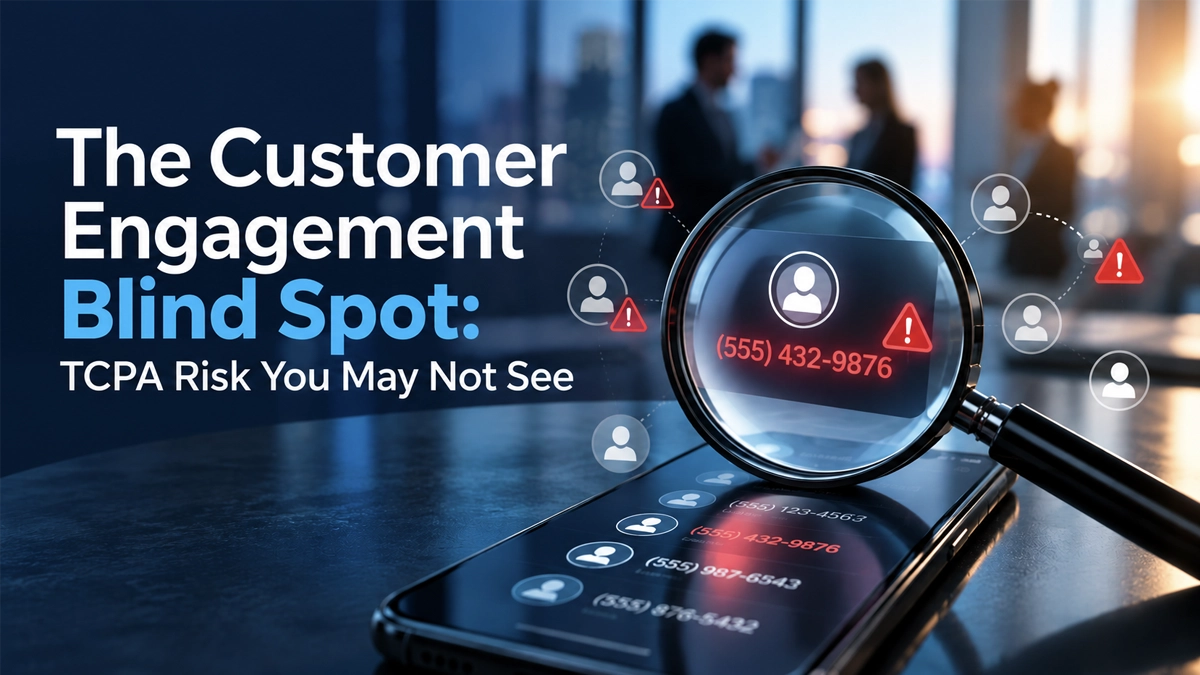
The Customer Engagement Blind Spot: TCPA Risk You May Not See
Consistently I hear, “I am not sure it matters, they’re already our customer.”
For most businesses, contacting an existing customer feels routine.
A billing reminder. A service update. A renewal notice. A collections call. An outage notification. A customer-care follow-up.
These are some of the ordinary parts of managing a customer relationship. But a significant compliance gap can appear when the business assumes that because the customer relationship is valid, the telephone number must still be valid too.
A customer relationship and a telephone number are not the same thing.
Telephone numbers are disconnected, recycled, and reassigned. When that happens, a number that once belonged to your customer may now belong to someone else. If the business continues relying on an outdated customer record, then a simple routine communication can quickly become a wrong-party contact.
That is where a data-quality issue becomes a compliance problem.
For executives, the important distinction is this: having a legitimate business reason to contact a customer does not eliminate every TCPA or Do Not Call consideration. The underlying risk may not be why the business is communicating; it may be who is actually receiving the call or text.
This becomes particularly important in customer databases, where telephone numbers may remain unchanged for years. A number can stay attached to a customer record long after the customer disconnected it. When that number is later reassigned, the business may unknowingly continue contacting a different individual who has no relationship with the company.
Businesses should periodically evaluate the telephone numbers associated with their customer records, particularly before high-volume, recurring, or automated outreach.
The executive question is simple:
Do you routinely validate whether the telephone number stored in your customer database is still associated with the customer you intend to contact?
Make the FCC Reassigned Numbers Database A Part of the Process
One practical control is the FCC Reassigned Numbers Database (RND).
The RND was created to help callers determine whether a telephone number has been permanently disconnected since a consent date or a date when the caller reasonably believed the number belonged to the intended consumer. The database returns Yes, No, or No Data based on the telephone number and date submitted.
That date matters. The RND does not independently prove who currently owns a telephone number. Instead, it helps identify whether a number was permanently disconnected after the date the business last knew it was associated with its customer.
A customer relationship may still be active while the telephone number on the account is no longer connected to that customer.
The FCC also provides a TCPA safe harbor in certain circumstances when a caller properly queries the database, receives a “No” response, and relies on that response when contacting a number that was later determined to have been reassigned.
TCPA penalties start at $1500 for each violation.
For executive leaders, RND screening should be viewed as part of customer-data governance and contact risk management, not simply as a telemarketing function.
Key Takeaways
- A valid customer relationship does not guarantee a valid telephone number.
- Reassigned numbers can create wrong party contact risk even when the original customer record was accurate.
- The RND can help identify how many telephone numbers no longer belong to your customers.
- Use the FCC RND as proactive check before appropriate customer outreach.
- Document your process. Retain the query date, date submitted, response, and related decision-making.
Routine customer engagement should remain routine. The key is making sure the number you are contacting still belongs in that relationship.
Nexxa Group operates at the intersection of data, marketing, and compliance, helping organizations turn complex consumer contact requirements into practical, scalable solutions. Through advanced data intelligence, managed services, APIs, and compliance expertise.
Sources: Reassigned Numbers Database | Federal Communications Commission
This article is provided for general informational and educational purposes only and does not constitute legal advice. Regulatory requirements, interpretations, and compliance obligations may vary based on specific facts and circumstances and are subject to change. Organizations should consult qualified legal counsel regarding the application of TCPA, Do Not Call, and other applicable laws and regulations to their specific business practices.