By Scott Rosenberg, Co-founder and CEO, 257
The U.S. retail electric market has always been challenging: retail electric providers (REPs) are competing against default providers who don’t have to make a profit on supply, customer acquisition is costly, and regulatory pressure is ever-present. Today’s rising energy costs and market volatility aren’t making it any easier.
But retailers have some fundamental advantages over utilities: you can choose who you serve, focusing your acquisition and retention efforts on households that are most attractive, and you can move faster in your use of data, AI, and controllable loads than the regulated, incumbent utility.
Retailers who act on these advantages – designing rate plans and customer acquisition strategies that precisely target attractive prospects – will come out on top, serving more customers more profitably.
Advanced targeting and personalization, however, require rich, accurate, real-time household intelligence.
“Retailers who design rate plans and customer acquisition strategies with precision targeting will come out on top, serving more customers more profitably.”
A new dawn: AI-powered customer acquisition & personalization
Personalized products aren’t new in other consumer verticals, but success in retail electric requires comprehensive insight into individual homes, occupants, and energy consumption patterns, as well as expected future behaviors.
Until recently, this data has been fragmented across numerous sources (utility bills, property records, satellite images, EV registrations), and some isn’t documented at all.
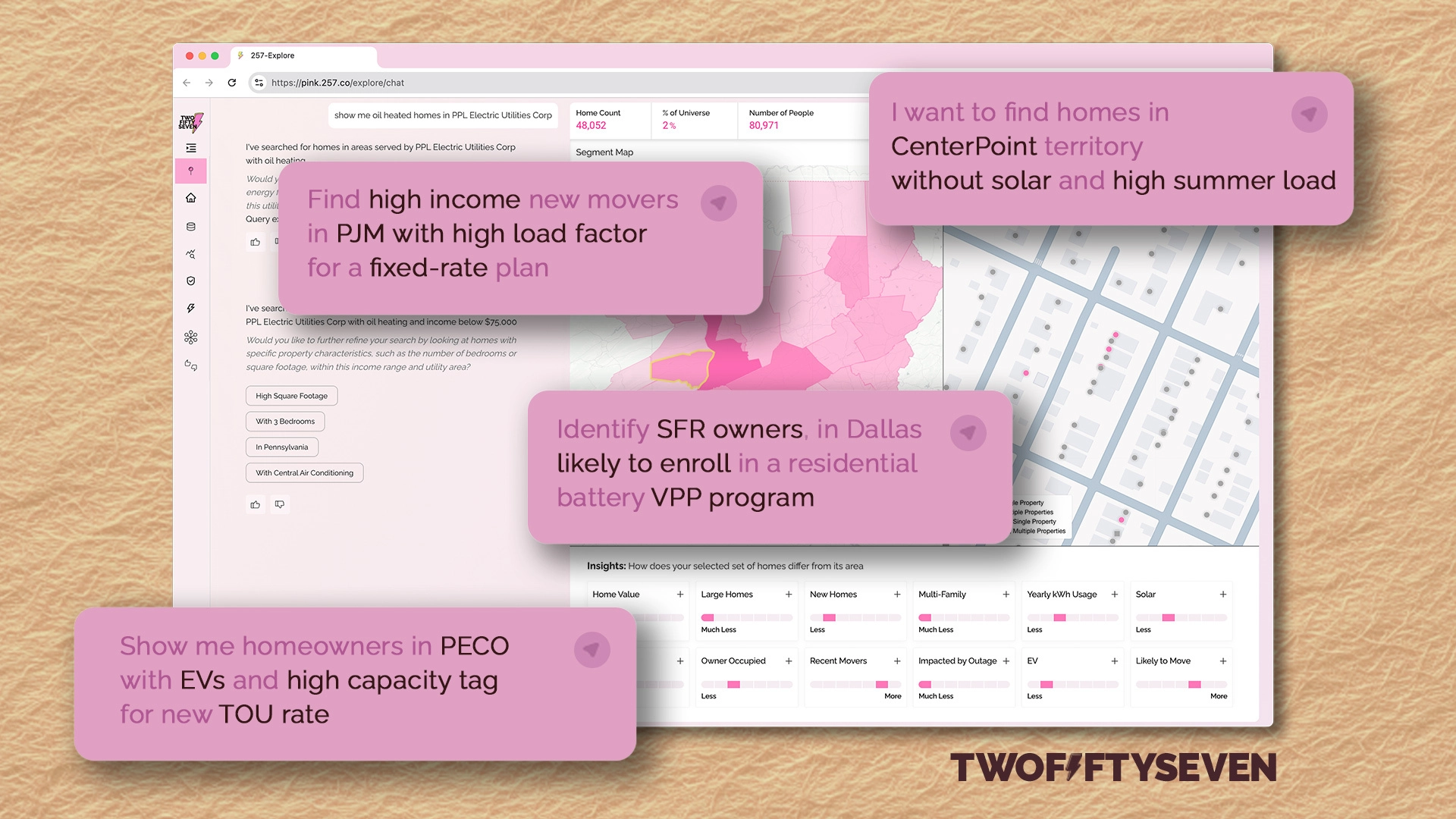
At 257, we’ve built digital energy twins for all 130M U.S. homes using AI and billions of energy data points. These profiles capture each home’s current energy characteristics and predict how they will evolve over time.
Across the country, leading-edge suppliers are proving just how powerful these insights can be. A retailer in PJM, for example, acquired 47% higher load factor homes at 29% lower cost, while a VPP operator in ERCOT accelerated battery sales by 30% over their prior efforts.
Together, we’re rewriting the playbook for acquiring and engaging customers – one built on precision targeting and personalization. Here’s what that playbook looks like.
Identify households most receptive to energy choice
One of the easiest ways to improve your top and bottom lines is to focus marketing budget on homes likely to switch. Predictive models that leverage a wide array of signals, including income, a recent sale or move, home investments, and electrification can distinguish households worth targeting from those that will simply waste ad spend and drive up your customer acquisition costs (CAC).
Prioritize households by expected profitability
Maximizing margins means seeking out and winning the customers least expensive to serve. This is simple in theory, but requires visibility into expected load profiles.
257 uses sample meter data to model the load, load factor, capacity tag for every residence in the U.S., enabling you to engage the most economic households. With confidence in their energy consumption and costs to serve, you can offer these prospects your best rates up front, boosting conversion.
Leverage flexible assets to innovate and differentiate
EVs, batteries, smart thermostats, and heat pumps are present in 31% of U.S. homes today, representing a huge opportunity for retailers to evolve their offerings into highly personalized, product-driven ones that save the consumer money while driving profitability.
There are many novel rate plans to pursue: overnight EV rate plans; demand response thermostat programs; and load-shifting battery programs. The trick is combining innovative rate design with the ability to efficiently find the homes most likely to enroll.
257’s platform identifies which homes already have these assets. Moreover, pioneering predictive models forecast a likelihood to adopt these assets and participate in a virtual power plant (VPP) program.
Taken together, these capabilities help REPs find and mobilize their best prospects.
Knowledge is power, literally
200+ REPs, utilities, solar and storage companies, and their marketing agencies use 257’s customer intelligence to accelerate growth while reimagining how consumers engage with energy.
Pink is the conversational interface to 257’s platform that anyone can use, regardless of technical background. Audience insights are free, and when you use them for your ad campaigns on Google, Meta, direct mail, or other media, you pay only on results.
For an industry founded on choice, there’s never been a better time to empower consumers with personalized energy solutions, while building portfolios that are more competitive and profitable in the process.
Key takeaways
By focusing acquisition and retention efforts on homes with the most attractive load profiles, retailers can grow both their customer base and margins
- Personalization and precision targeting are now possible with AI built for the retail electric market, trained on billions of home energy data points
- 257’s digital energy twins capture current energy characteristics and predict how they will evolve over time for all 130M U.S. homes
- Retailers can use 257 to identify households most receptive to energy choice or flexible plans, prioritize them by expected profitability, and target them across Google, Meta, direct mail, or other media
- 257 customers have acquired 47% higher load factor homes and grown battery sales by 30% while lowering CAC
Company information
257’s predictive intelligence helps electric retailers acquire more valuable customers for less. Powered by digital energy twins for all 130M homes in the U.S., 257 is helping 200+ retail electric, solar, HVAC, and utility companies rewrite the playbook for engaging consumers on energy – one built on personalization and precision targeting.
Learn more about 257 here: https://257.co
Follow 257 on LinkedIn here: https://www.linkedin.com/company/twofiftyseven/
About the author:
Scott Rosenberg Co-founder and CEO, 257Scott Rosenberg is co-founder and CEO of 257, a venture-backed NYC company using large datasets and AI to accelerate the home energy transition. 257 builds digital energy twins for 130M U.S. homes, helping partners in energy, HVAC, and solar identify and engage households most likely to benefit from their products and services. Previously, Scott launched and led Roku’s advertising and media business, scaling it to billions in revenue and a public company.
Connect with Scott on LinkedIn here: https://www.linkedin.com/in/scottarosenberg/