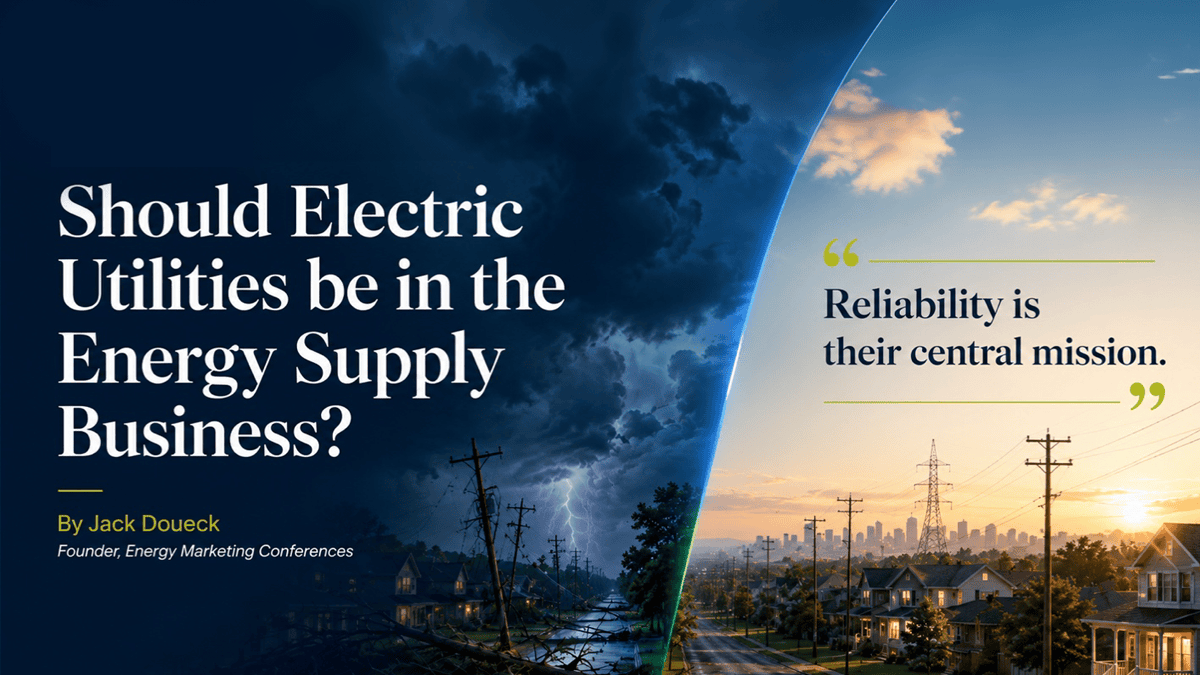
Should Electric Utilities be in the Energy Supply Business?
By Jack Doueck
When the Lights Go Out
On the evening of July 3rd, 2026, my family gathered at our home in Oakhurst, New Jersey, looking forward to a quiet holiday weekend. After days of oppressive heat, a sudden windstorm swept through. It lasted barely ten minutes.
Then the lights went out.
Our home was one of more than 300,000 served by Jersey Central Power & Light (JCP&L) that lost electricity. In 100-degree heat, we spent nearly 24 hours without power. We threw away most of the contents of our refrigerators and freezers and waited. By the following evening, tens of thousands of New Jersey families were still without electricity.
A Simple Question
As we sat in the dark, my daughter asked a simple question:
“Dad, you’re in the energy business. Why does this seem to happen every summer? Shouldn’t the utility be focused on preventing outages like this?”
It is a fair question, and one that raises a broader issue about the role of electric utilities.
The Utility’s Central Mission
Electric utilities are regulated monopolies. Customers cannot choose who owns the poles, wires, substations, and transformers that deliver electricity to their homes. In exchange for that monopoly, utilities are permitted to earn a guaranteed rate of return on the billions of dollars they invest in maintaining and expanding the electric grid.
Their central mission is reliability.
Yet in New Jersey and several other states, utilities perform another function that has little to do with restoring power after storms: they also procure and sell electricity to customers through default supply programs. They spend the time computing their “Price to Compare” and put it on all their bills – even the ones that are supplied by others.
That raises an important question: Should regulated electric utilities be in the energy supply business at all?
Two Very Different Responsibilities
Competitive energy suppliers already serve millions of customers, competing on price, products, and service. Purchasing electricity in wholesale markets requires forecasting prices, managing procurement, administering supply programs, and communicating pricing to customers. These are important functions — but they are fundamentally different from maintaining a resilient electric grid.
Every hour executives devote to energy procurement is an hour not devoted to strengthening infrastructure, modernizing equipment, or improving storm response.
A Clearer Division of Roles
Several jurisdictions (such as Houston and Dallas) have moved toward models in which utilities focus primarily on transmission and distribution while competitive suppliers or independent procurement agencies handle default energy purchasing. This approach creates a clearer mission, sharper accountability, and performance metrics centered on what customers care about most: keeping the lights on.
Whether or not such a model ultimately lowers costs, it unquestionably clarifies responsibility. Utilities should succeed or fail based on the reliability of the electric system—not on their ability to buy electricity in wholesale markets.
Let Utilities Focus on Reliability
Regulated monopolies enjoy guaranteed customers and the opportunity to earn risk-free returns because they perform an essential public service. That public service is not selling electricity. It is delivering electricity safely, reliably, and efficiently.
Perhaps it is time to let competitive markets handle energy procurement—and allow utilities to focus exclusively on the mission only they can perform.
Jack Doueck is the founding principal of AEC Energy Management, Grid Power Direct, Energy Marketing Conferences, and Advanced Energy Capital.