By Jack Doueck
For the first time in decades, America may not have enough electricity.
Not long ago, many people believed nuclear energy was an industry of the past.
Today, it may be one of the most important technologies shaping America’s future.
I recently interviewed Jake Jurewicz, Founder and CEO of Blue Energy, on The Energy Insider Podcast. Our discussion, “Reinventing Nuclear: Powering America’s Future,” explored why nuclear energy is making a remarkable comeback—and why this time may be different.
Jake, an MIT-trained nuclear engineer and former strategist at Exelon, believes the greatest obstacle facing nuclear power isn’t the technology itself.
It’s construction.
For decades, the nuclear industry has been trapped by projects that routinely take 10 to 15 years to complete and run billions of dollars over budget. Blue Energy is attacking that problem by applying advanced shipbuilding and modular manufacturing techniques to build reactors largely off-site, then assemble them in the field.
If successful, this approach could cut construction schedules to as little as three years while dramatically lowering costs—making nuclear projects far more attractive to investors and utilities.
It’s a simple idea with potentially game-changing implications.
Why Nuclear Is Back
The timing could hardly be more urgent.
After years of flat electricity demand, America is entering a period of unprecedented growth.
AI data centers, the electrification of transportation, the reshoring of manufacturing, population growth, and the retirement of coal-fired generation are all driving electricity demand higher. At the same time, businesses and consumers increasingly want power that is not only affordable, but reliable and carbon-free.
Renewable energy will keep expanding, but solar and wind alone cannot provide electricity every hour of every day.
That is where nuclear power enters the conversation.
Unlike intermittent renewables, nuclear plants provide dependable, around-the-clock baseload generation regardless of weather.
A Remarkable Turnaround
The renewed enthusiasm for nuclear power would have seemed unimaginable just a decade ago.
Public confidence collapsed after the partial meltdown at Three Mile Island in 1979. Dozens of planned reactors were canceled, and for nearly forty years the United States built virtually no new large nuclear plants.
The nation’s attention shifted to natural gas, wind, and solar.
Today, the conversation has changed dramatically.
According to the Pew Research Center, about 60 percent of Americans now support building additional nuclear power plants—a sharp increase from just a few years ago.
Technology companies have become some of nuclear energy’s strongest advocates.
Microsoft signed a 20-year agreement with Constellation Energy to restart the shuttered reactor at Three Mile Island—now renamed the Crane Clean Energy Center—to help power its expanding AI infrastructure.
Other tech companies are investing heavily in advanced nuclear technologies as they search for reliable, emissions-free electricity to meet rapidly growing computing demands.
Reinventing the Business Model
Our discussion wasn’t simply about reactors.
It was about rethinking the entire business model of nuclear power.
Blue Energy is working to improve every stage of the process—from construction and financing to permitting and deployment.
Rather than treating each project as a one-of-a-kind engineering exercise, the company aims to manufacture reactors more like ships or aircraft, where standardized designs, factory production, and repeatable processes drive down costs while improving quality.
That philosophy could transform nuclear power from an occasional mega-project into a scalable energy source.
Beyond Earth
Perhaps the most fascinating part of our conversation: the future of nuclear energy may extend well beyond our own planet.
NASA and the White House have announced plans to develop compact nuclear reactors capable of providing reliable electricity on the Moon, where two-week-long lunar nights make solar power impractical.
Looking farther ahead, nuclear propulsion systems could shorten travel times to Mars while carrying larger scientific payloads.
What About Fusion?
While today’s nuclear plants rely on fission, researchers continue pursuing fusion—the same process that powers the sun.
Fusion promises virtually limitless clean energy with little long-lived radioactive waste, though significant engineering challenges remain before commercial deployment becomes reality.
Companies such as Helion Energy, Commonwealth Fusion Systems, and TAE Technologies are pouring billions of dollars into bringing commercial fusion online within the next decade.
Whether those ambitious timelines prove achievable remains to be seen.
Looking Ahead
No one knows exactly what America’s energy mix will look like ten or twenty years from now.
Natural gas will continue to play a major role. Renewables will keep expanding. Battery storage will improve. Energy efficiency will remain essential.
But one conclusion is increasingly difficult to ignore:
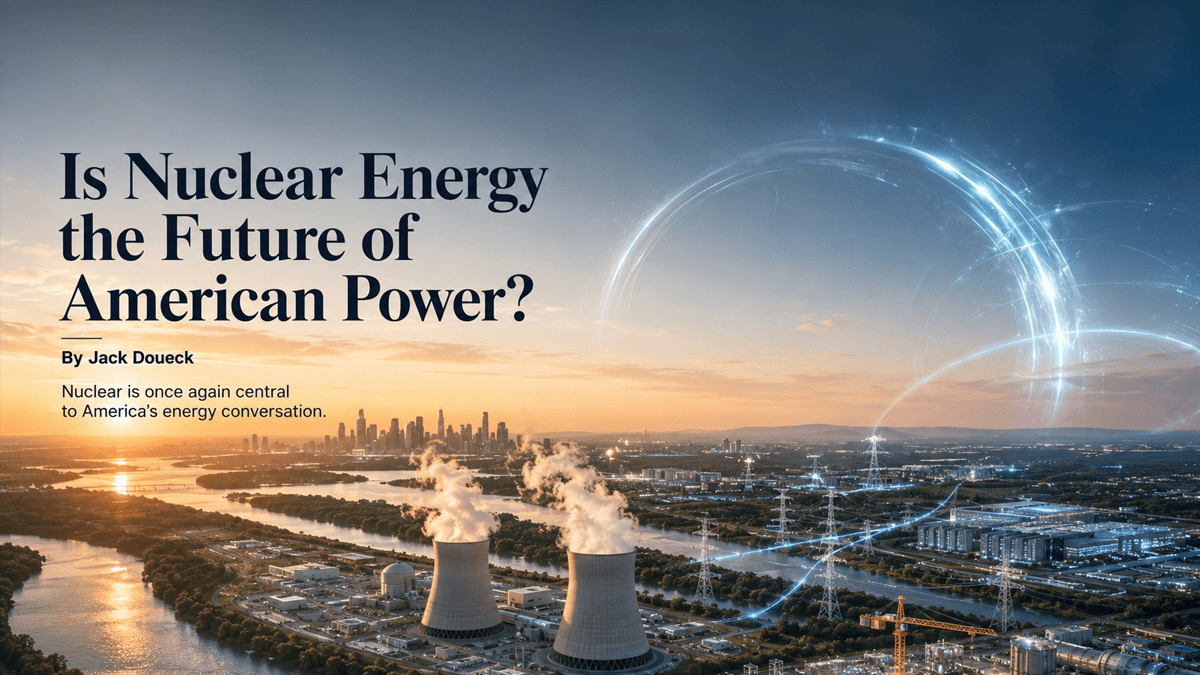
Nuclear power is once again central to America’s energy conversation.
If companies like Blue Energy can dramatically reduce the cost and time required to build reactors, they may help solve one of the nation’s greatest infrastructure challenges—reliable, affordable, carbon-free electricity for a rapidly growing economy.
To learn more about the nuclear energy revolution, tune into “The Energy Insider” Podcast.
Jack Doueck is the Co-Founder of Grid Power Direct, AEC Energy Management, Energy Marketing Conferences, Advanced Energy Capital and the host of The Energy Insider Podcast.