
By Jack Doueck
The Fall Energy Marketing Conference is taking place October 19-20, 2026 in Washington D.C. and the theme is “America 250: Energy Innovation to Power the Future.”
I have been accused of being a “serial entrepreneur” since I began launching start-ups following the financial crisis in 2008. Over the past four decades, my partners and I have started roughly two dozen businesses. Most did not survive. However those that made it were driven by one defining force: innovation.
If I could bottle it, I would.
That raises a simple but important question: Where does innovation actually come from?
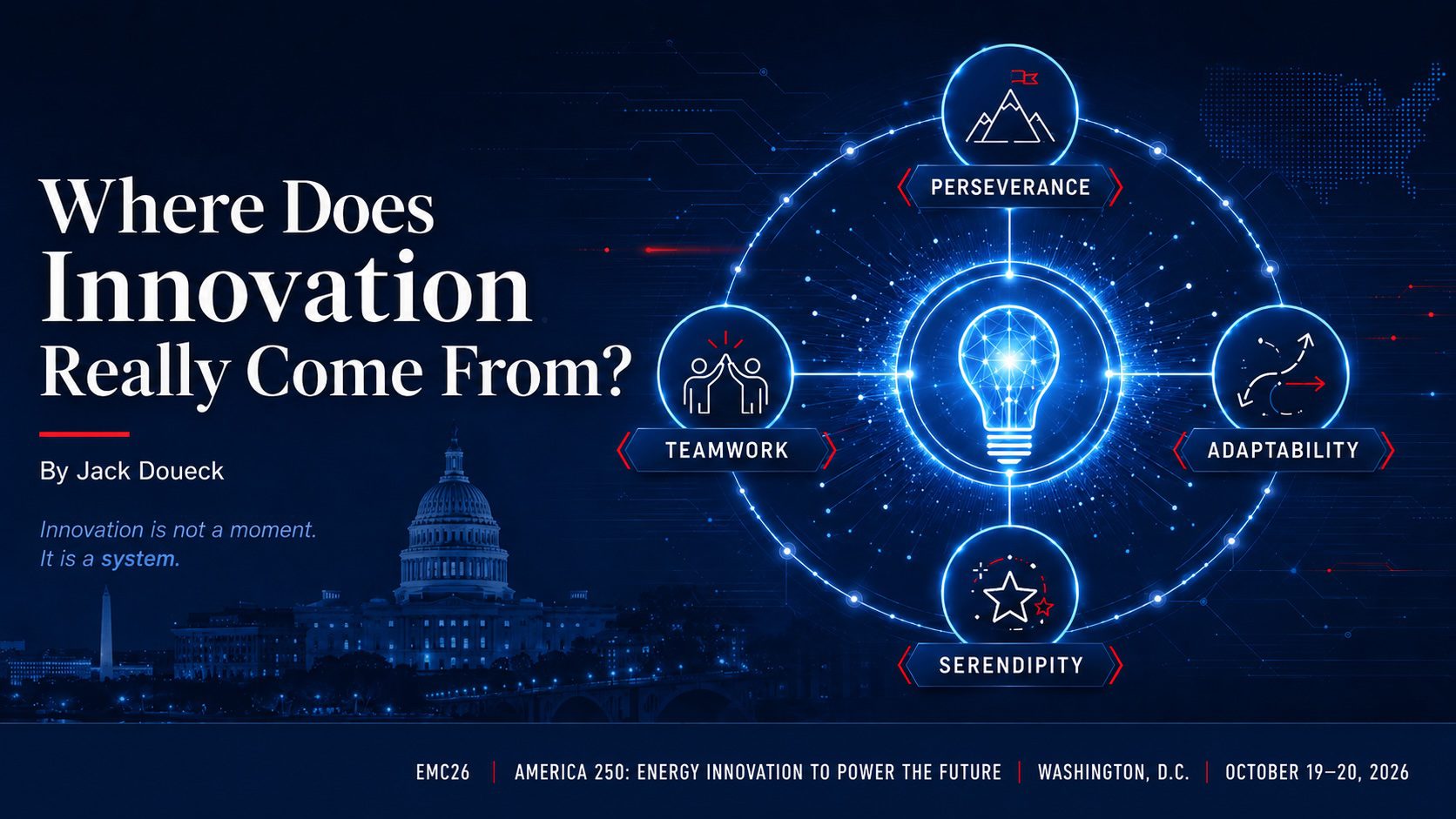
There is no single formula. But after decades in business, I’ve come to believe it consistently emerges from four ingredients: perseverance, teamwork, adaptability, and serendipity.
Perseverance
The idea that success is “1% inspiration and 99% perspiration” is a cliché because it is largely true.
Much has been written about persistence, but one concept that popularized the modern understanding of mastery is the “10,000-hour rule,” introduced in Outliers: The Story of Success. The argument is simple: achieving world-class capability requires sustained, deliberate practice over time.
Innovation follows a similar pattern. Breakthroughs rarely come from a single insight; they come from repeated effort, refinement, and endurance through uncertainty.
This idea is echoed in Think and Grow Rich, where Napoleon Hill recounts the story of R.U. Darby during the Colorado Gold Rush.
Darby and his uncle discovered promising gold ore and invested heavily in mining. When the vein suddenly disappeared, they kept digging, unsuccessfully. Eventually, they gave up and sold their equipment for scrap.
The buyer brought in a mining engineer, studied the geology and resumed digging.
He struck gold just three feet from where Darby had stopped.
The lesson is not blind persistence, it is that success often lies just beyond the point where most people abandon effort, usually when paired with better insight or perspective.
There Is No “I” in Team
One of the most enduring myths in innovation is the lone genius. Even figures like Thomas Edison are often misunderstood in this regard.
In reality, most major breakthroughs are the product of collaborative environments, not isolated individuals.
Research consistently shows that small, well-structured teams are more likely to produce meaningful innovation. The most effective teams are typically diverse in background and perspective, with enough cognitive variety to generate novel combinations of ideas.
The size of the team is also important. Studies show that teams tend to perform best at around five members before diminishing returns set in.
History reinforces this pattern.
When Edison developed the practical electric light system in 1879, he was part of a global wave of parallel experimentation. British inventor Joseph Swan was developing similar technology at the same time. Edison’s contribution was not solitary invention—it was systematization and commercialization within a broader ecosystem of discovery.
This phenomenon, known as “simultaneous invention,” appears repeatedly throughout history:
- Newton and Leibniz independently developing calculus
- Bell and Gray filing telephone-related patents on the same day
Even modern innovations, such as the iPhone, were not the product of a single mind, but rather years of layered contributions across engineering, design, materials science, and prior technologies such as BlackBerry and touchscreen development.
Innovation is rarely singular; it is cumulative.
The Flexibility to Pivot
Some of the most transformative innovations in history emerged not from initial success, but from unexpected failure.
Across the last century, the United States has been particularly prolific in turning “accidents” into industries.
Examples are well known:
- Viagra originated as a treatment for cardiovascular conditions
- Penicillin emerged from a contaminated petri dish
- Potato chips were created after an irritated chef over-thinned potatoes
- Popsicles were invented by an 11-year-old who left a drink outside overnight
- Corn flakes emerged from stale, unintended food processing outcomes
The list extends further: Post-it Notes, super glue, microwave ovens, Teflon, safety glass, and many more all originated from unintended consequences.
A consistent pattern emerges: the original objective failed, but the innovators noticed something unusual, investigated it, and pivoted rather than discarded it.
In innovation, failure is not the opposite of success. It is often the raw material for it.
Serendipity
We often attribute innovation to deliberate genius. In reality, chance plays a far larger role than we tend to acknowledge.
Consider the enduring myth of Isaac Newton sitting under a tree when an apple falls and instantly discovering gravity. The truth is more subtle and more important.
Isaac Newton did not “discover gravity” in a moment of inspiration. Rather, he observed an ordinary event and asked an extraordinary question: why do objects always fall toward the Earth, and could the same force extend to the Moon?
That line of inquiry (developed over years, not seconds), ultimately led to his theory of universal gravitation.
Serendipity, properly understood, is not luck. It is the ability to recognize value in unexpected information. The term itself refers to finding something valuable you were not actively seeking.
Modern innovation is often a blend of structured effort and randomness. Companies attempt to systematize creativity, but many of the most important breakthroughs emerge from unplanned intersections of ideas.
One useful framework is presented in The Science of Serendipity by Matt Kingdon, which argues that organizations can actually design environments that increase the likelihood of productive “accidents.”
In other words, serendipity is not something you wait for, it is something you can cultivate.
Conclusion
If there is a unifying theory of innovation, it may be this:
Innovation is not a moment; it is a system.
It is built through:
- Perseverance when progress is slow
- Teams that multiply ideas rather than isolate them
- Flexibility to pivot when assumptions fail
- Serendipity that turns the unexpected into opportunity
Organizations that consistently innovate do not rely on genius or luck. They build environments where all four forces are present and reinforced.
Join us in Washington DC to for EMC26 to continue the discussion!
Jack Doueck is an energy entrepreneur and investor who has founded multiple companies, including Advanced Energy Capital and Energy Marketing Conferences. He is also an author and host of The Energy Insider Podcast